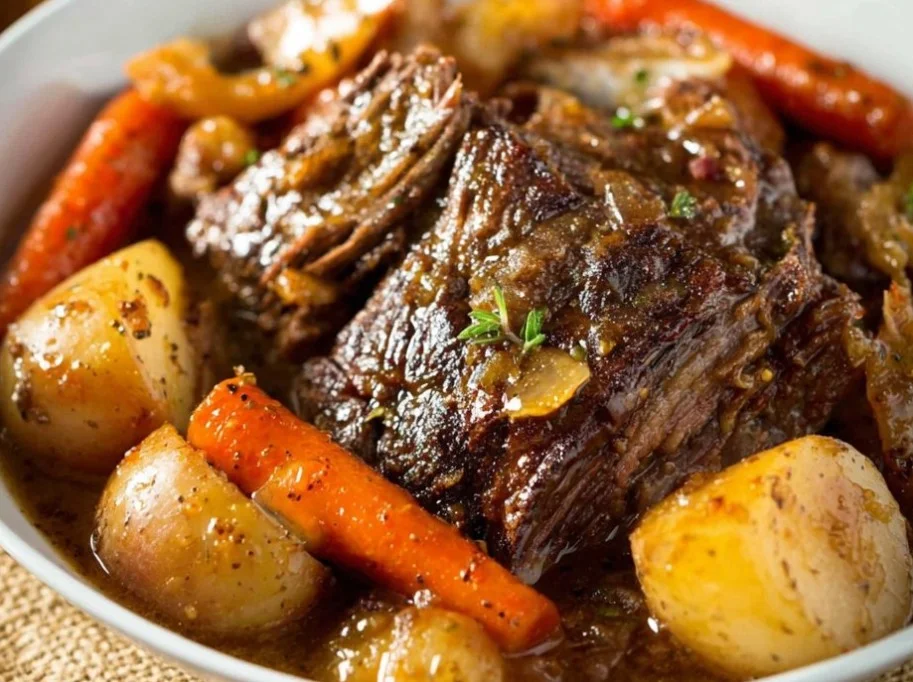
Start with the sound of the slow cooker clicking on and the smell of searing beef — that first deep-brown crust says dinner is happening. This recipe serves a crowd (or makes smart leftovers), packs protein and iron, and hits comfort-food cravings without fuss; studies show slow braising preserves nutrients and tenderness. Close your eyes and imagine the warm, herb-scented steam as you lift the lid, that’s the payoff. If you like hearty slow-cooker dinners with serious staying power, try this variation inspired by a high-protein slow-cooker soup I love for a different weeknight idea.
Print
Ultimate Slow Cooker Pot Roast
- Total Time: 495 minutes
- Yield: 6 servings 1x
- Diet: None
Description
A hearty and comforting pot roast that cooks effortlessly in a slow cooker, delivering tender, flavorful meat with a savory blend of vegetables.
Ingredients
- 3 to 4 pounds chuck roast
- 1 tablespoon olive oil
- 1 onion, chopped
- 4 cloves garlic, minced
- 4 carrots, sliced
- 3 potatoes, diced
- 2 cups beef broth
- 2 tablespoons Worcestershire sauce
- 1 teaspoon dried thyme
- 1 teaspoon dried rosemary
- Salt and pepper to taste
Instructions
- Heat olive oil in a skillet over medium-high heat. Season the chuck roast with salt and pepper, then sear it until browned on all sides.
- Transfer the roast to a slow cooker. Add the chopped onions, minced garlic, sliced carrots, and diced potatoes around the roast.
- In a bowl, mix together beef broth, Worcestershire sauce, thyme, and rosemary. Pour the mixture over the roast and vegetables.
- Cover and cook on low for 8-10 hours or on high for 4-6 hours, until the meat is tender.
- Remove the roast and vegetables, let them rest for a few minutes, then slice the roast and serve with the vegetables.
Notes
For maximum tenderness, use low heat for a longer time rather than rushing on high. Searing the meat is essential for flavor.
- Prep Time: 15 minutes
- Cook Time: 480 minutes
- Category: Main Course
- Method: Slow Cooking
- Cuisine: American
Nutrition
- Serving Size: 1 serving
- Calories: 550
- Sugar: 5g
- Sodium: 700mg
- Fat: 35g
- Saturated Fat: 10g
- Unsaturated Fat: 20g
- Trans Fat: 0g
- Carbohydrates: 25g
- Fiber: 5g
- Protein: 45g
- Cholesterol: 120mg
Why This Ultimate Slow Cooker Pot Roast Never Fails
There’s a practical reason every home cook should have one reliable pot roast method: slow, moist heat turns inexpensive chuck into fork-tender slices with minimal babysitting. This recipe is built around low effort and big flavor — sear for depth, aromatics for background, long, slow braise for melt-in-your-mouth texture. Consider it the culinary equivalent of a good pair of boots: solid, dependable, and ready for anything from a family Sunday dinner to a rainy-weeknight rescue.
Ingredient Lineup
- 3 to 4 pounds chuck roast
- 1 tablespoon olive oil
- 1 onion, chopped
- 4 cloves garlic, minced
- 4 carrots, sliced
- 3 potatoes, diced
- 2 cups beef broth
- 2 tablespoons Worcestershire sauce
- 1 teaspoon dried thyme
- 1 teaspoon dried rosemary
- Salt and pepper to taste
These are straightforward pantry and produce items that work together to create savory depth and classic roast flavors.
The Smart Sequence
- Heat olive oil in a skillet over medium-high heat. Season the chuck roast with salt and pepper, then sear it in the skillet until browned on all sides. Mini-tip: Don’t crowd the pan — good contact is what creates flavor, so brown in batches or use a heavier pan.
- Transfer the roast to a slow cooker. Add the chopped onions, minced garlic, sliced carrots, and diced potatoes around the roast. Mini-tip: Lift the roast onto a bed of vegetables to keep root vegetables from overcooking at the bottom.
- In a bowl, mix together beef broth, Worcestershire sauce, thyme, and rosemary. Pour the mixture over the roast and vegetables in the slow cooker. Mini-tip: Salt the broth lightly; you can always finish seasoning at the end but over-salting early concentrates too much.
- Cover and cook on low for 8-10 hours or on high for 4-6 hours, until the meat is tender. Mini-tip: If you want the thickest gravy, remove the roast and vegetables, skim fat, then reduce the cooking liquid on the stovetop before returning meat to sauce.
- Remove the roast and vegetables, let them rest for a few minutes, then slice the roast and serve with the vegetables. Mini-tip: Resting lets the juices redistribute; slice against the grain for the most tender bite.
This step-by-step keeps things simple and uses one expert tweak per step so you don’t have to learn the hard way.
Balanced Bites
A realistic nutrition snapshot for one serving (recipe yields about 6 servings): about 550 calories, 45 grams of protein, 25 grams of carbohydrates, 35 grams of fat, and roughly 5 grams of fiber. These numbers are estimates and vary with exact meat trimming, potato portion, and whether you spoon off fat.
The dish delivers a strong protein punch from the chuck roast, iron and B vitamins for energy, and fiber-plus-complex carbs from the root vegetables. If you’re balancing macronutrients, pair this plate with a simple green vegetable to up the micro-nutrients without adding many calories.
Perfect Pairings
Serve this pot roast family-style right from the slow cooker or platter. It’s lovely with bright, lightly dressed greens (arugula or baby spinach) that cut the richness, or roasted Brussels sprouts for a caramelized contrast. Wine lovers: choose a medium-bodied red like Merlot or a fruity Cabernet Franc. For beers, a malty brown ale complements the roasted notes. This recipe is ideal for cool-weather gatherings and holiday rehearsals — think casual Sunday dinners, cozy weeknights, or a hands-off meal for guests. For an alternative hearty side, the sausage-and-potato chowder recipe makes an excellent second-course inspiration when you want to switch up textures without reinventing the wheel.
How to Store It Right
Fridge: Cool leftovers within two hours, store in airtight containers, and keep for up to 3 to 4 days. Freezer: Place meat and vegetables with some of the braising liquid in a freezer-safe container and store for up to 3 months; label with date. Best reheating methods: gently reheat on the stovetop in a covered pan over low heat, stirring occasionally and adding a splash of broth if the liquid has reduced; you can also rewarm in a 325°F oven covered for 20 to 30 minutes. For microwave convenience, reheat in short bursts and stir to distribute heat. Freshness tip: when freezing, leave a little headspace and freeze in shallow portions so thawing is quick and even.
Expert Tips
- Use a bone-in roast if you can; the marrow adds depth and richness during long braising.
- Low and slow is the rule: for maximum tenderness, favor low heat for a longer time rather than rushing on high.
- Finish the sauce properly: remove fat, then thicken with a cornstarch slurry or reduce on the stove for a glossy gravy.
- Use fresh herbs at the end if available: a scattering of fresh parsley or thyme brightens the plate.
- Slice against the grain after resting; it makes even a budget cut behave like a luxury bite.
These are the little moves that separate a decent pot roast from a memorable one.
Flavor Experiments
- Seasonal: Apple-cider and sage twist — replace half the beef broth with apple cider and add a couple of quartered apples for autumn warmth and gentle sweetness.
- Gourmet: Red wine and porcini — deglaze the searing pan with a cup of red wine and add rehydrated porcini mushrooms to the braise for deep umami.
- Playful: Chipotle and cumin — for a smoky, Southwestern take, stir in one chopped chipotle in adobo and a teaspoon of ground cumin to the broth for a bold flavor change.
These variations let you tailor the roast for holidays, date nights, or weeknight creativity without changing technique.
Learn from My Mistakes
- Mistake: Skipping the sear. Fix: Always brown the roast well; it’s where much of the roast’s flavor is born.
- Mistake: Overcrowding the cooker with too many vegetables on the bottom. Fix: Place the roast on a small bed of veggies or use a rack; vegetables cook through but don’t mush.
- Mistake: Over-salting at the start. Fix: Season lightly early and adjust at the end after the sauce has reduced.
- Mistake: Cutting too soon. Fix: Rest the meat for at least 10 minutes before slicing to keep juices locked in.
These are quick course corrections that will save dinners and reputations.
What to Do with Leftovers
- Make pot roast sandwiches: pile sliced meat on crusty rolls, spoon thickened gravy over, and melt cheese under the broiler for an incredible next-day melt.
- Transform into shepherd’s pie: chop the roast, combine with leftover vegetables and gravy, top with mashed potatoes, and bake until golden.
- Hearty soup booster: dice leftover roast and add to a slow cooker or pot with broth, beans, and vegetables for a quick, protein-rich soup; for a creamy chicken-soup-style texture and extra protein inspiration, see this creamy slow-cooker soup idea for a textural guide.
Leftovers are not second-rate here; they’re the foundation for new, fast dinners.
FAQs
Q: How do I know when the roast is done and not dry?
A: You’re looking for tenderness, not a specific internal temperature. Done pot roast should pull apart easily with a fork; test with a fork at the thickest point after 6-8 hours on low. If it resists, it simply needs more time.
Q: Can I skip searing to save time?
A: You can, but the flavor depth will be noticeably flatter. Searing only takes minutes and creates the Maillard reactions that give roast its characteristic savory notes. If you must skip, compensate with extra aromatics and a splash of soy or Worcestershire.
Q: Is chuck roast the only cut that works?
A: Chuck is ideal for its connective tissue that melts into gelatin during long cooking; brisket and shoulder are alternatives. Lean cuts like sirloin will dry and are not recommended for slow braising.
Q: Can I add wine or tomatoes to the braise?
A: Yes — both are classic. Substitute part of the beef broth with red wine for richness, or add a small can of crushed tomatoes for acidity. Adjust seasoning to taste after cooking.