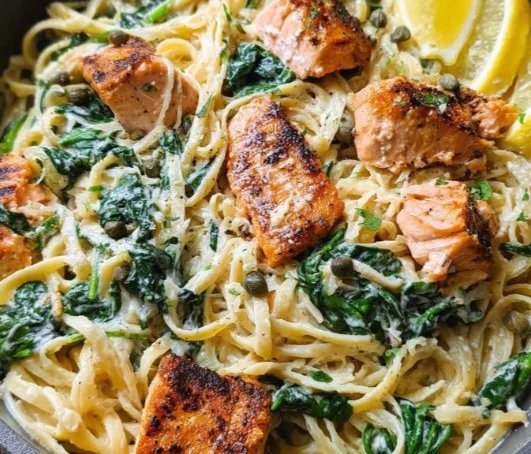
Three minutes into the first bite you’ll believe it took all afternoon to make, but the truth is this pasta comes together fast and feeds a crowd with minimal fuss. Salmon delivers about 22 grams of protein per 3-ounce serving and the spinach adds a vitamin A and iron boost while the lemon zest wakes the whole dish up with a bright scent. If you want a higher-protein spin, I like comparing variations like this one to other riffs on salmon pasta for ideas; see my spin that punches protein even higher at 30g protein salmon pasta with spinach. This is the kind of weeknight payoff that feels gourmet.
Print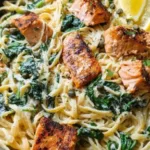
Creamy Salmon Pasta
- Total Time: 30 minutes
- Yield: 4 servings 1x
- Diet: Pescatarian
Description
A quick and easy creamy salmon pasta that’s ready in 30 minutes, perfect for a gourmet weeknight dinner.
Ingredients
- Nonstick cooking spray
- 2 salmon fillets (about 3/4 pound)
- 1 teaspoon kosher salt (divided, plus more for pasta water)
- 1/2 teaspoon ground black pepper (divided)
- 12 ounces linguine
- 2 tablespoons unsalted butter
- 3 garlic cloves (minced)
- 1 1/4 cups heavy cream
- 1/2 cup dry white wine
- 1 teaspoon grated lemon zest
- 5 ounces baby spinach (1 box)
- 2 tablespoons capers
- Lemon wedges (for garnish)
Instructions
- Preheat the oven to 350°F and heat a large pot of water to boiling.
- Spray a small rimmed baking pan with nonstick spray. Place the salmon skin side down on the pan, then sprinkle with 1/2 teaspoon salt and 1/4 teaspoon pepper. Bake for 14 to 16 minutes until almost opaque with an internal temperature of 145°F.
- While the salmon bakes, add a large pinch of salt to the boiling water and cook the linguine according to package instructions for al dente.
- In a skillet, heat butter over medium heat, add garlic, and cook for 1 minute.
- Add cream, wine, lemon zest, remaining salt, and pepper to the skillet. Bring to a boil, then reduce heat to medium and cook for 5 to 6 minutes until thickened. Lower the heat.
- Add spinach and capers to the skillet, drain pasta and add to the skillet, tossing to combine and wilt the spinach.
- Remove salmon from the oven, remove skin, and break into chunks over the pasta. Serve with lemon wedges for garnish.
Notes
For a lighter version, consider using half-and-half instead of heavy cream and increasing the spinach for volume.
- Prep Time: 10 minutes
- Cook Time: 20 minutes
- Category: Main Course
- Method: Baking
- Cuisine: Italian
Nutrition
- Serving Size: 1 serving
- Calories: 700
- Sugar: 5g
- Sodium: 550mg
- Fat: 35g
- Saturated Fat: 20g
- Unsaturated Fat: 12g
- Trans Fat: 0g
- Carbohydrates: 60g
- Fiber: 4g
- Protein: 40g
- Cholesterol: 80mg
The Essentials
- Nonstick cooking spray
- 2 salmon fillets (about 3/4 pound (1 large fillet is also fine))
- 1 teaspoon kosher salt (divided, plus more for pasta water)
- 1/2 teaspoon ground black pepper (divided)
- 12 ounces linguine
- 2 tablespoons unsalted butter
- 3 garlic cloves (minced)
- 1 1/4 cups heavy cream
- 1/2 cup dry white wine
- 1 teaspoon grated lemon zest
- 1 box baby spinach (5 ounces)
- 2 tablespoons capers
- Lemon wedges (for garnish (optional))
Step-by-Step Method
- Preheat oven to 350 degrees F and heat large pot of water to boiling on stove. Spray small rimmed baking pan with nonstick spray. Place salmon, skin side down, on prepared pan and sprinkle with 1/2 teaspoon salt and 1/4 teaspoon pepper. Transfer to oven and bake 14 to 16 minutes or until salmon is almost opaque throughout and internal temperature reaches 145 degrees F. Expert tip: use an instant-read thermometer and pull salmon at 140 degrees F since carryover will finish it; that avoids the chalky overcooked texture.
- Meanwhile, add large pinch of salt to pot of boiling water and cook linguine according to package instructions for al dente. Expert tip: set a timer for 1 minute less than the package if you plan to finish the pasta in the sauce so it doesn’t go floppy.
- While pasta is cooking, heat butter in large high-sided skillet over medium heat. Add garlic and cook 1 minute, stirring constantly. Add cream, wine, lemon zest and remaining 1/2 teaspoon salt and 1/4 teaspoon pepper. Heat to boiling over medium-high heat, then reduce heat to medium and cook 5 to 6 minutes or until mixture is thickened to a thin sauce consistency, stirring frequently. Reduce heat to low. Expert tip: simmer gently; a vigorous boil will separate the cream and leave a grainy sauce.
- Add spinach and capers to skillet. Drain pasta and add to skillet on top of spinach. Cook over low heat 1 to 2 minutes, tossing frequently, or until spinach is just wilted. Expert tip: toss with tongs so you coat each strand and keep the sauce glossy — don’t let it sit and absorb all the cream.
- Remove salmon from oven. Slip spatula between salmon skin and flesh to remove skin; discard skin and break salmon into large chunks over pasta. Serve garnished with lemon wedges for squeezing over pasta, if desired. Expert tip: break into generous chunks rather than flaking tiny pieces; it creates texture contrast and prevents fish from turning mushy in the sauce.
Nutrition Breakdown
A sensible serving of this creamy salmon pasta (about 1 1/4 to 1 1/2 cups) provides roughly: about 650 to 750 calories per serving depending on portion and exact ingredients, approximately 35 to 40 grams of protein, 60 to 75 grams of carbohydrates, 30 to 40 grams of fat, and around 3 to 5 grams of fiber. These are estimates since pasta brand, cream richness and fillet size change totals.
Health insight: this dish offers a solid balance of protein and healthy fats from salmon, but if you want to cut calories swap half-and-half for some of the cream and increase spinach for volume.
Perfect Pairings
Serve this pasta straight from the skillet so it stays silky and warm. A crisp green salad with a lemony vinaigrette is the obvious foil — something simple like arugula, shaved fennel and a squeeze of lemon cuts the cream and echoes the pasta’s brightness. Pair with a chilled Sauvignon Blanc or a dry Pinot Grigio to mirror the wine used in the sauce. For a cozy winter evening, a light roasted vegetable side like broccolini or roasted Brussels sprouts makes the plate feel seasonal and satisfying.
How to Store It Right
Refrigerator: Cool leftovers to room temperature, cover tightly or transfer to an airtight container, and refrigerate for up to 3 days.
Freezer: Cream-based pasta generally loses sauce texture when frozen, so I do not recommend freezing the fully dressed dish; if you must, store sauce separately and freeze for up to 1 month.
Reheat: Rewarm gently in a skillet over low heat with a splash of milk or cream and a tablespoon of butter to restore creaminess, tossing until just hot.
Freshness tip: add a squeeze of lemon and a few extra capers when reheating to refresh flavors and cut through any lost brightness.
Expert Tips
- Salt timing matters: generously salt your pasta water so the linguine is seasoned through; it’s the simplest flavor hack.
- Texture control: undercook the pasta by about 60 seconds and finish it in the skillet with the sauce to let it marry and hold a toothsome bite. For an extra glossy finish, finish with a small pat of cold butter at the end. Try oven-baked salmon tips if you’re double-batching fillets.
- Don’t overcrowd the pan with spinach: add it in batches if your skillet is small so it wilts evenly and doesn’t steam into a soggy pile.
Flavor Experiments
- Seasonal – Spring lemon-herb: stir in 2 tablespoons chopped fresh dill and a handful of peas when you add the spinach for a bright, spring-forward plate.
- Gourmet – Saffron and lobster idea: infuse the cream with a pinch of saffron and top with a few quick-seared lobster medallions for a dinner-party upgrade.
- Playful – Smoky chipotle: add 1/2 teaspoon chipotle powder to the sauce and garnish with charred corn for a smoky-sweet twist that kids tolerate surprisingly well.
Learn from My Mistakes
- Mistake: Overcooked salmon that flakes to dust. Fix: Pull salmon at about 140 degrees F and let residual heat finish it; rest 2 minutes before flaking.
- Mistake: Sauce that breaks or becomes grainy. Fix: Reduce heat and simmer gently; if separation begins, whisk in a tablespoon of cold butter off the heat to bring it back.
- Mistake: Watery finished pasta because you rinsed the noodles. Fix: Never rinse; reserve a cup of the pasta water instead and use it to thin the sauce if needed.
- Mistake: Too-salty end result. Fix: Taste as you go and remember the capers add salt; be conservative when salting early.
What to Do with Leftovers
- Pan-fried pasta cake: press leftover pasta into a hot nonstick skillet with a little oil, cook until crispy and golden on both sides, flip like a giant patty and serve with a fried egg.
- Pasta-stuffed peppers: mix with extra chopped spinach and a bit more cream, stuff into halved bell peppers, top with breadcrumbs and bake until warm and bubbly.
- Cold pasta salad (playful second-day): toss chunks of salmon with a light lemon-herb vinaigrette, add extra capers and chopped cucumber for a different, cooler meal.
Quick Questions
Q: How long will the pasta hold if I want to prep ahead?
A: Cook and cool the pasta slightly, then toss with a teaspoon of olive oil and store separately from the sauce in an airtight container for up to 2 days. Reheat together on low with a splash of cream to marry flavors.
Q: Can I swap cream for a lighter option without losing the sauce?
A: Yes. Use half-and-half with a tablespoon of cornstarch dissolved in a little cold water to help thicken, or finish with a tablespoon of mascarpone off heat for richness without as much heavy cream.
Q: Is it safe to reheat salmon in cream sauce?
A: Absolutely, if you reheat gently on low and do not let the sauce come to a hard boil. Add a splash of milk to loosen the sauce and stir frequently to avoid overcooking the fish.
Q: How do I make this dairy-free?
A: Substitute full-fat coconut milk for cream and finish with a squeeze of lemon; the flavor will shift but the silkiness remains. Use dairy-free butter or olive oil for the initial sautée.