
I remember the first time I made salmon with spinach cream sauce for a weeknight dinner: it looked like a restaurant plate within 20 minutes and vanished in under five. Packed with omega-3s and a comforting hit of cream, this dish balances bright greens with rich sauce and a crispy seared crust you can hear when it hits the table. If you want a protein-forward supper that feels special without fuss, this recipe delivers, fast, reliable, and deeply satisfying. For a different protein-packed spin or to skirt the cream, check out this 30g protein salmon pasta with spinach for inspiration.
Print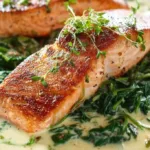
Salmon with Spinach Cream Sauce
- Total Time: 20 minutes
- Yield: 2 servings 1x
- Diet: Pescatarian
Description
A quick and satisfying weeknight dish featuring salmon seared to perfection and served with a rich spinach cream sauce.
Ingredients
- 2–3 teaspoons olive oil
- 2 6 oz salmon filets
- 1 tablespoon butter
- 2 cloves garlic, peeled and minced
- 1 small shallot, finely chopped
- 1/2 cup heavy cream
- 1/4 cup vegetable broth
- 1/4 teaspoon red pepper flakes
- 9–12 oz fresh spinach leaves, washed
- 1 tablespoon flat leaf Italian parsley, chopped
- Kosher salt and freshly ground black pepper, to taste
Instructions
- Pat the salmon filets dry with a paper towel.
- Heat olive oil in a large skillet over medium high heat until shimmering.
- Add salmon, skin side up, and sear for 3 minutes until light brown.
- Flip and continue cooking for another 2-3 minutes, depending on thickness.
- Remove the salmon from the pan and set aside.
- Wipe excess oil from the pan if necessary, then add butter, garlic, and shallot; cook for 1-2 minutes.
- Add vegetable broth, red pepper flakes, and cream; bring to a low simmer.
- Stir until the sauce thickens and reduces by almost half.
- Add spinach and stir until lightly wilted, about 2-3 minutes.
- Season with salt and pepper to taste.
- Nestle the salmon back into the sauce and top with parsley.
Notes
For a lighter option, substitute heavy cream with Greek yogurt or light cream.
- Prep Time: 10 minutes
- Cook Time: 10 minutes
- Category: Main Course
- Method: Searing and Simmering
- Cuisine: American
Nutrition
- Serving Size: 1 serving
- Calories: 520
- Sugar: 6g
- Sodium: 450mg
- Fat: 38g
- Saturated Fat: 20g
- Unsaturated Fat: 15g
- Trans Fat: 0g
- Carbohydrates: 8g
- Fiber: 2g
- Protein: 40g
- Cholesterol: 100mg
Why This Salmon with Spinach Cream Sauce Never Fails
This recipe earns its spot in the weeknight rotation because it hits three simple goals: quick cooking, bold flavor, and textural contrast. A hot pan gives you that coveted crispy edge on the salmon while the quick cream sauce softens and colors the spinach without overcooking it. Follow the timing and a few little technique points below, and you’ll have an impressive plate that cooks nearly itself. This is the kind of recipe friends ask for, and you can scale it up without fretting.
What You’ll Need
- 2-3 teaspoons olive oil
- 2 6 oz salmon filets, skin on or off as you prefer
- 1 tablespoon butter
- 2 cloves garlic, peeled and minced
- 1 small shallot, finely chopped
- 1/2 cup heavy cream
- 1/4 cup vegetable broth
- 1/4 teaspoon red pepper flakes
- 9-12 oz fresh spinach leaves, washed and tough stems removed
- 1 tablespoon flat leaf Italian parsley, chopped
- Kosher salt and freshly ground black pepper, to taste
If you prefer a lighter or cream-free route, there’s a good guide at 30g protein salmon pasta without cream that swaps the sauce approach while keeping the spirit of the dish. Keep ingredients trimmed to this list and you’ll avoid cluttering flavors; each item plays a clear role.
Step-by-Step Method
- Pat the salmon filets dry with a paper towel. (Tip: Dry fish sears; moisture steams. Press gently to remove surface moisture for the crispiest crust.)
- Heat olive oil in a large skillet over medium high heat, until shimmering. Be careful that it doesn’t smoke. (Tip: If oil smokes, lower the heat and start again; overheated oil blunts flavor and burns seasoning.)
- The pan must be hot so the salmon doesn’t stick to it and gets nice and crispy. (Tip: Test by tilting the pan—if the oil flows smoothly and ripples, it’s ready.)
- Add salmon, skin side up and sear for 3 minutes, until light brown. (Tip: Don’t move the fish during searing; letting the crust form is what releases it from the pan.)
- Flip and continue to cook for another 2-3 minutes or more, skin side down, depending on the thickness of your salmon and well-cooked you want it. Times are for medium to medium well. (Tip: For even doneness, press the thicker end into the pan briefly after flipping.)
- Remove the salmon from pan and set aside. (Tip: Resting the fish briefly keeps juices locked in; tent loosely with foil for 2 minutes.)
- If there is a lot of excess oil in the pan, wipe it with a paper towel. (Tip: Leave a thin sheen for flavor but too much oil will make the sauce greasy.)
- Add butter along with the garlic and shallot, cooking for 1-2 minutes, stirring often with a wood spoon. (Tip: Keep the heat medium to avoid burning the garlic; fragrant and translucent is the goal.)
- Add vegetable broth, red pepper flakes, and cream, bringing everything to a low simmer over medium heat. (Tip: A low simmer melds flavors without breaking the cream.)
- Stir consistently until the sauce thickens and reduces by almost half. (Tip: This concentrates flavor; if it reduces too far, add a splash more broth.)
- Add spinach and stir until lightly wilted – around 2-3 minutes. (Tip: Toss in batches if your pan is crowded; crowded spinach steams instead of wilting elegantly.)
- Season the spinach cream sauce with salt and pepper to taste. (Tip: Taste as you go—salt after reduction to avoid over-salting.)
- Nestle the salmon filets back into the spinach cream sauce and top with parsley. (Tip: Spoon some sauce over the tops to finish; a quick flash in the pan with the salmon in it for 30 seconds unites everything.)
If you like a little extra silky lift, finish with a squeeze of lemon right before serving. For a creamy avocado variation of the sauce idea that stays light and bright, see this 36g protein salmon creamy avocado sauce — great for keeping the green theme while switching textures.
Nutrition Breakdown
A sensible serving is one 6 oz salmon filet with approximately one-quarter of the sauce and spinach per plate. Estimated nutrients per serving: calories about 520, protein roughly 40 grams, carbohydrates around 6-8 grams (mostly from shallot and any veggies you add), fat approximately 36-38 grams (thanks to the cream and salmon’s healthy fats), and fiber about 2-3 grams. This dish is a strong source of omega-3 fatty acids, high-quality protein, and vitamin K and iron from the spinach. Swap heavy cream for Greek yogurt or light cream for a lower-fat option while preserving protein.
Perfect Pairings
Serve this salmon over something that soaks up the sauce: buttered egg noodles, creamy polenta, or a bed of herbed mashed potatoes are classic choices. For lighter meals, roasted new potatoes and lemony couscous or a simple whole-grain pilaf work beautifully. Crisp sides to cut the creaminess: a fennel and orange salad or a lemony arugula toss with shaved Parmesan. Wine-wise, pick a medium-bodied white like a Chardonnay with modest oak or a dry Riesling; for reds, a chilled Pinot Noir complements salmon without overwhelming it. This recipe shines in late spring or early autumn when fresh spinach is at its peak.
How to Store It Right
Fridge: Store cooled components in airtight containers for up to 3 days; keep salmon and sauce separate if possible to preserve texture. Freezer: Cooked salmon can be frozen in a shallow airtight container for up to 1 month, though cream-based sauces degrade in texture after freezing. Reheat: Gently warm the sauce in a skillet over low heat, stirring in a tablespoon of broth or milk to loosen it; add salmon at the end and heat just until warmed through to avoid drying it out. Freshness tip: Add a splash of lemon when reheating; brightness revives flavor and masks any slight dulling from storage.
Expert Tips
- Salt in stages: Season the salmon before searing, then again to taste after the sauce reduces; layered seasoning tastes deeper than one-time salting.
- Control the crust: Use a heavy-bottomed skillet and make sure it is fully hot before adding the salmon to avoid sticking and to achieve even searing.
- Manage creaminess: If the sauce feels too rich, add vegetable broth or a splash of white wine to stretch and brighten it without watering down flavor.
- Texture contrast: If you like crunch, finish with toasted pine nuts or sliced toasted almonds sprinkled on top just before serving.
- Timing is everything: Cook the spinach briefly to preserve color and nutrients; it should be tender, not mushy.
Flavor Experiments
- Seasonal (spring): Stir in a handful of fresh peas and lemon zest into the sauce for a verdant, bright lift.
- Gourmet: Add a teaspoon of Dijon mustard and a splash of dry white wine to the sauce, finish with a small pat of cold butter off heat for glossy richness.
- Playful: Stir in a spoonful of sun-dried tomato pesto or chopped roasted red peppers for a sweet-savory twist that kids often love.
Mistakes to Avoid
- Overcrowding the pan – Fix: Cook salmon in batches or use a larger skillet so each filet gets full contact with the hot surface for a proper sear.
- Burning the garlic – Fix: Add garlic only when the shallot is translucent and keep the heat moderate; burned garlic becomes bitter.
- Reducing too far – Fix: Watch the sauce closely and remove from heat when it coats the back of a spoon; if it tightens too much, add a splash of broth.
- Serving cold salmon – Fix: Rest fish briefly after searing; reheat gently in the sauce for 30-60 seconds to bring it back to temperature.
- Using overdried spinach – Fix: Use fresh leaves and add them directly; frozen spinach must be well-drained and added later to avoid excess water.
What to Do with Leftovers
- Salmon salad: Flake leftover salmon, fold into Greek yogurt or mayo with chopped celery, capers, lemon, and dill for sandwiches or lettuce cups.
- Creamy pasta toss: Warm the sauce, add a splash of pasta cooking water, toss with al dente pasta and flaked salmon for an effortless lunch.
- Breakfast scramble: Chop the salmon and stir into scrambled eggs with a bit of the chilled sauce spooned in at the end for a decadent morning treat.
FAQs
How can I tell when salmon is perfectly cooked without cutting into it?
Cook salmon until it flakes easily with a fork but still has a slightly translucent center; for a 6 oz filet this usually means about 3 minutes per side on medium-high heat then a short rest. Carryover heat will finish it nicely.
Is there a lighter substitute for heavy cream that won’t curdle?
Use half-and-half or a mix of milk and a tablespoon of cornstarch to stabilize, or finish with Greek yogurt off-heat to avoid separation. Keep the sauce below a simmer to prevent curdling.
Can I use frozen salmon for this recipe?
Yes, but thaw completely and pat very dry to avoid steaming the fish. Thinner portions cook faster—adjust times—and pre-season when thawed for best flavor.
How do I keep the spinach vibrant and not soggy?
Wilt spinach briefly over medium heat, toss quickly, and remove from direct heat once soft; residual heat finishes it without turning it limp.